
.svg)

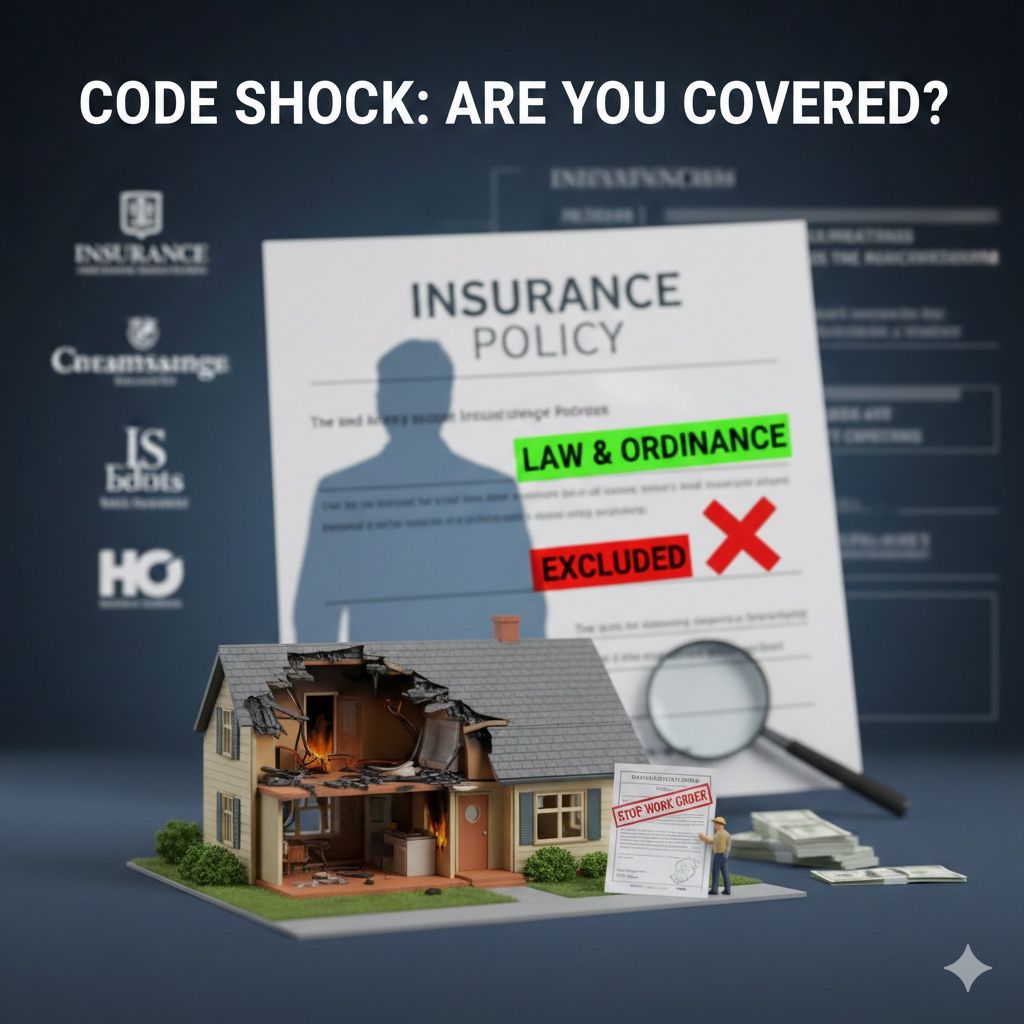

It's a common misconception that all standard Homeowners (HO-3) policies are created equal. Many people treat insurance like a commodity, but nothing could be further from the truth, especially when it comes to one of the most critical and often overlooked components: Law & Ordinance Coverage.
If you've ever had a major claim, you know the unexpected expenses can pile up fast. But what happens when the local building authority tells you that to rebuild your kitchen or repair your roof, you must upgrade the plumbing, wiring, or structural elements to meet current building codes?
That's where Law & Ordinance coverage steps in.
The Good News (The Industry Standard)
For years, it was a general rule of thumb that most quality homeowners insurance policies (HO-3) included a baseline amount of Law & Ordinance coverage—often set at 10% of your dwelling coverage (Coverage A).In plain English, this means: If a covered event (like a fire or major storm) forces you to pull a building permit, and the municipality mandates that you upgrade to a newer, more expensive building code, your insurance company covers that increased cost, up to that specified limit.
The Alarming Trend You Need to Check
Unfortunately, in a move to control costs, some of the largest, national insurance carriers have quietly begun removing this coverage from their standard policies or dramatically reducing the default limits.
This means for many homeowners, Law & Ordinance coverage is no longer "baked in."
Instead, you may now be required to:
1. "Buy Back" the coverage as an optional endorsement, adding it back into your policy for an extra premium.
2. Increase the limits beyond the standard 10% (e.g., to 25%, 50%, or 100% of your dwelling limit) if you live in an older home or an area with rapidly evolving codes.
🛑 Why This Is Not a Detail You Can Skip
This is more than just an obscure clause; it's a potential financial catastrophe.
Imagine this scenario:
• You own a 1970s home valued at $300,000.
• A kitchen fire causes $75,000 in damage.
• The city inspector says the entire wall of that kitchen must be upgraded to current fire-blocking standards and requires a new sub-panel for the electrical.
• The cost of these mandatory code upgrades is $15,000.If you do not have Law & Ordinance coverage, your insurance pays the $75,000 for the damaged property, but you are personally responsible for the $15,000 in required code upgrades before you can live in the home again.
The Takeaway: Policies are NOT a Commodity
This coverage illustrates a core truth about insurance: An insurance policy is a promise, and each insurer has a different way of handling that promise (and the resulting claims).
Never assume your policy is the same as your neighbor's or the same as the one you had last year.